

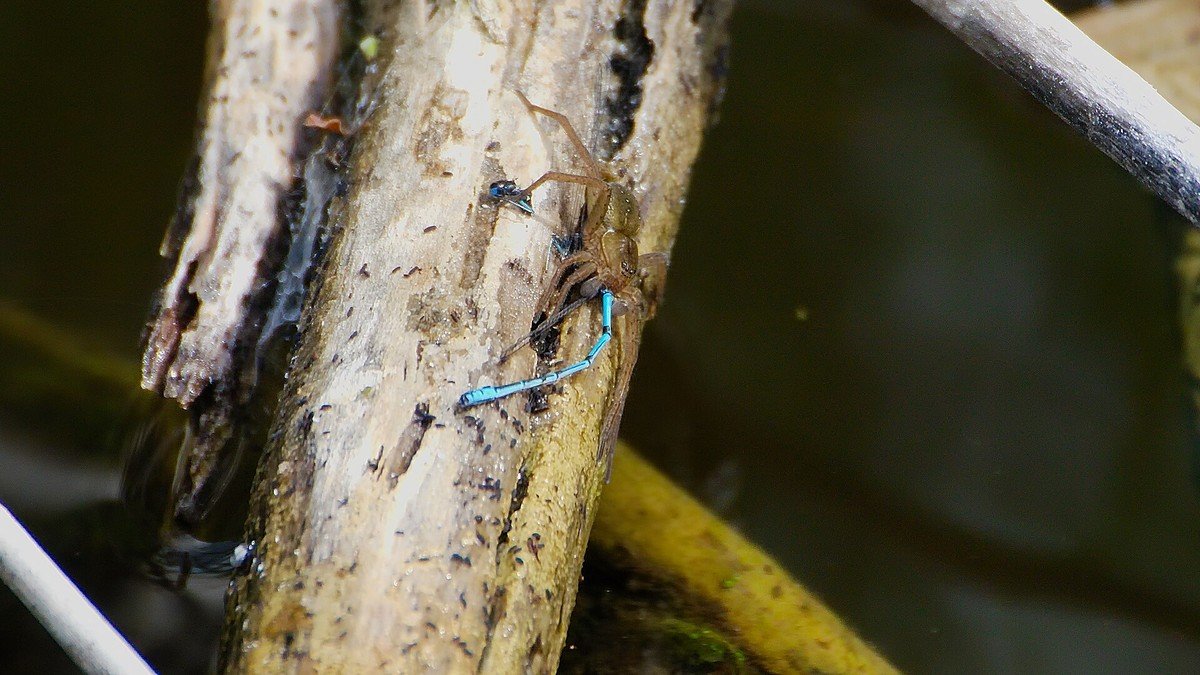
One of Britain's rarest and most striking invertebrates—the palm-sized, fish-eating Fen Raft Spider (Dolomedes plantarius)—has staged a dramatic conservation comeback, reaching an estimated record population of 3,750 breeding females across 12 wetland sites in the United Kingdom. Announced on Friday by the Royal Society for the Protection of Birds (RSPB), the milestone marks a transformative turnaround for a species that stood on the verge of national extinction just 14 years ago.
As the largest of the UK's roughly 670 spider species, a fully grown female Fen Raft Spider can reach a leg span of 7 to 8 centimeters, big enough to cover an adult human hand. Sporting a velvety chocolate-brown body bordered by distinctive cream or yellow stripes, the semi-aquatic arachnid uses fine sensory hairs on its legs to detect vibrations on the surface of freshwater ditches, skimming across the water to ambush pond skaters, dragonfly larvae, tadpoles, and even small three-spined stickleback fish.
From Three Isolated Ponds to Thriving Norfolk Marshes
By 2010, decades of wetland drainage, water pollution, and habitat fragmentation had reduced the Fen Raft Spider to just three isolated populations in the UK—at Redgrave and Lopham Fen on the Norfolk-Suffolk border, the Pevensey Levels in East Sussex, and a canal in South Wales. To prevent genetic collapse, biologist Dr. Helen Smith, working alongside Natural England, the RSPB, Suffolk Wildlife Trust, and zoos across Britain, launched an ambitious translocation and captive-rearing program.
Because young spiders are cannibalistic when kept together, volunteers painstakingly hand-reared thousands of tiny spiderlings inside individual glass test tubes, feeding each one fruit flies with tweezers until they were large enough to be released into pristine grazing marshes across the Norfolk Broads. Favorable wet spring conditions this year, combined with careful water-level management across the RSPB's Mid Yare nature reserves—including Strumpshaw Fen, Buckenham Marshes, and Cantley Marshes—propelled the count of silky white nursery webs to an all-time high.
“The Fen Raft Spider is one of the UK's rarest invertebrates, as big as an adult hand, and seeing its population reach 3,750 breeding females shows the remarkable power of wetland habitat restoration.” — Tim Strudwick, RSPB Mid Yare Nature Reserves Site Manager
A Vital Indicator for British Wetland Biodiversity
Ecologists track the population each late summer and autumn by counting the tennis-ball-sized 'nursery webs' spun by female spiders high in the spiky leaves of water soldier plants and sedges, where each mother guards up to 700 spiderlings. At RSPB Strumpshaw Fen and neighboring Mid Yare marshes alone, wardens recorded more than 1,600 nursery webs this season, confirming that the reintroduced colonies are now self-sustaining and spreading naturally along connected ditch networks.
Despite its fearsome size to arachnophobes, conservationists stress that Dolomedes plantarius is an elusive, strictly wetland specialist that never enters houses and dives underwater—where it can remain submerged for up to an hour by trapping air bubbles against its body hair—whenever disturbed. Wildlife groups say the spider's recovery demonstrates how restoring clean, unpolluted freshwater habitats benefits an entire ecosystem of threatened British species, from bitterns and marsh harriers to Norfolk hawker dragonflies and water voles.
Frequently Asked Questions
How large is the Fen Raft Spider and is it dangerous to humans?
With a leg span reaching 7 to 8 centimeters—roughly the size of an adult human palm—the Fen Raft Spider is the UK's largest spider, but it is shy, lives only in wetland ditches, and poses no danger to people.
How did conservationists bring the Fen Raft Spider back from the brink of extinction in Britain?
Starting in 2010, conservationists hand-reared thousands of spiderlings in individual test tubes before releasing them into restored grazing marshes and reedbeds in Norfolk and Suffolk.



Comments (0)
Log in to join the discussion.