

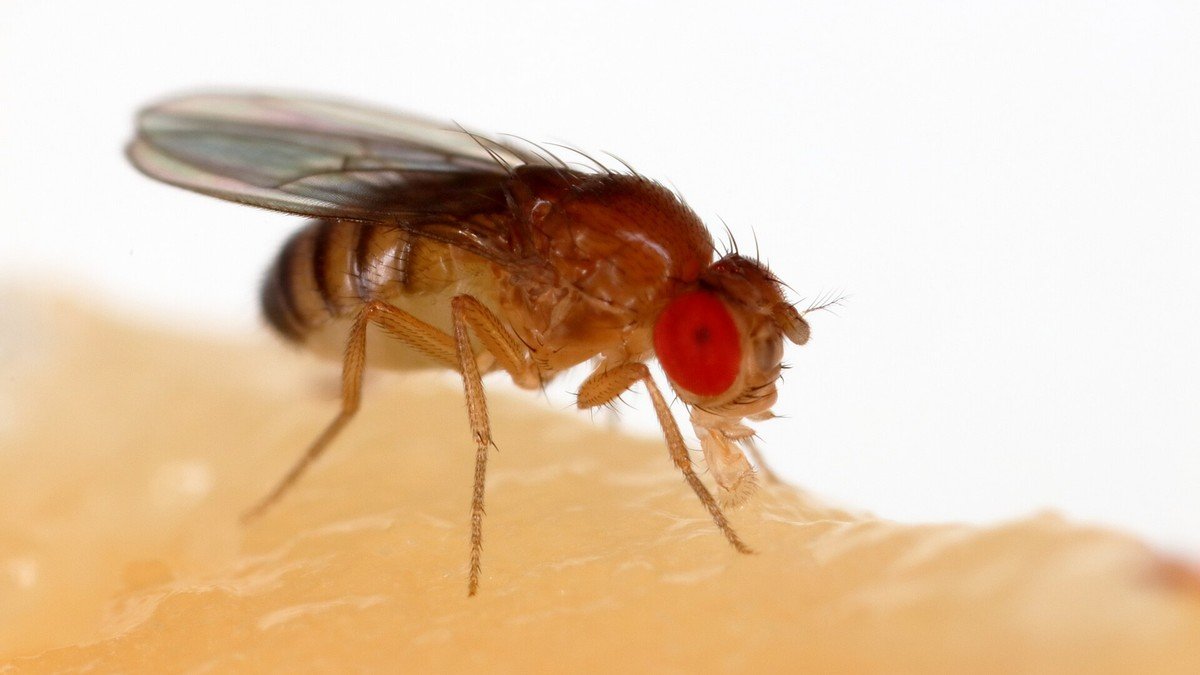
An international coalition of neuroscientists, computer scientists, and citizen volunteers known as the FlyWire Consortium has unveiled the first complete neuron-by-neuron synaptic wiring diagram—or connectome—of an adult fruit fly brain. Published as a landmark nine-paper collection in the journal Nature and co-led by researchers at Princeton University, the University of Cambridge, and the Medical Research Council (MRC) Laboratory of Molecular Biology, the atlas charts all 139,255 neurons and 54.5 million synapses inside the brain of an adult female Drosophila melanogaster.
Although the brain of a fruit fly measures less than one millimeter across—smaller than a poppy seed—it packs roughly 149.2 meters of intricate biological wiring capable of governing flight, binocular vision, spatial navigation, associative memory, grooming, and melodic courtship songs. Prior to the FlyWire milestone, the only organisms with completely mapped whole-brain connectomes were the nematode worm Caenorhabditis elegans (302 neurons), the marine worm Platynereis dumerilii, and a larval fruit fly (3,016 neurons).
Electron Microscopy, AI Segmentation, and Global Proofreading
Constructing the map began with a raw dataset captured in 2018 by Davi Bock and colleagues at the Howard Hughes Medical Center's Janelia Research Campus, who sliced a single female fly brain into 7,050 ultra-thin 40-nanometer sections and imaged them using high-speed transmission electron microscopy. To turn those 21 million high-resolution grayscale micrographs into a three-dimensional wiring diagram, Princeton professors Sebastian Seung and Mala Murthy developed machine-learning algorithms to trace cell membranes and synaptic junctions automatically.
Because artificial intelligence alone still makes tracing errors across microscopic gaps, the Princeton team built an open collaborative platform that enabled 287 researchers across more than 140 laboratories worldwide—alongside dedicated citizen-science gamers—to manually proofread and annotate every neuron. Collaborators led by Gregory Jefferis in Cambridge and Philipp Schlegel classified the brain's circuitry into 8,453 distinct cell types, more than half of which (4,581) had never been described before.
“If we want to understand how the brain works, we need a mechanistic understanding of how all the neurons fit together and let you think. Having the complete adult fly connectome is transformative for neuroscience.” — Sebastian Seung, Professor of Neuroscience and Computer Science at Princeton University
Simulating Brain-Wide Signals and Future Mammalian Maps
Companion studies in the Nature package already demonstrate the predictive power of the open-access database. In one experiment, Princeton researchers built a computational model of the entire connectome that accurately predicted which downstream motor circuits would fire when sweet or bitter taste receptors were stimulated, achieving over 90 percent agreement with live neuroimaging recordings. Other papers traced the complete visual pathways for color and motion detection as well as the specific 'halt' neurons that command a walking fly to pause.
Because Drosophila shares roughly 60 percent of its DNA with humans—including three-quarters of known human disease-related genes—researchers say the connectome provides an indispensable blueprint for studying neurological disorders and inspiring energy-efficient artificial intelligence architectures. Building on the tools perfected in FlyWire, neurobiologists are now setting their sights on mapping the complete mouse brain connectome, which contains roughly 70 million neurons—a 500-fold leap in scale.
Frequently Asked Questions
How many neurons and synapses were mapped in the adult fruit fly connectome?
The FlyWire connectome charts all 139,255 neurons and 54.5 million synaptic connections inside the brain of an adult female Drosophila melanogaster.
Why is the adult fruit fly brain map considered a breakthrough for neuroscience?
Before this achievement, the most complex complete brain wiring diagram belonged to a fruit fly larva with 3,016 neurons; the adult fly brain is nearly 50 times larger and controls walking, flight, vision, navigation, and courtship.




Comments (0)
Log in to join the discussion.