

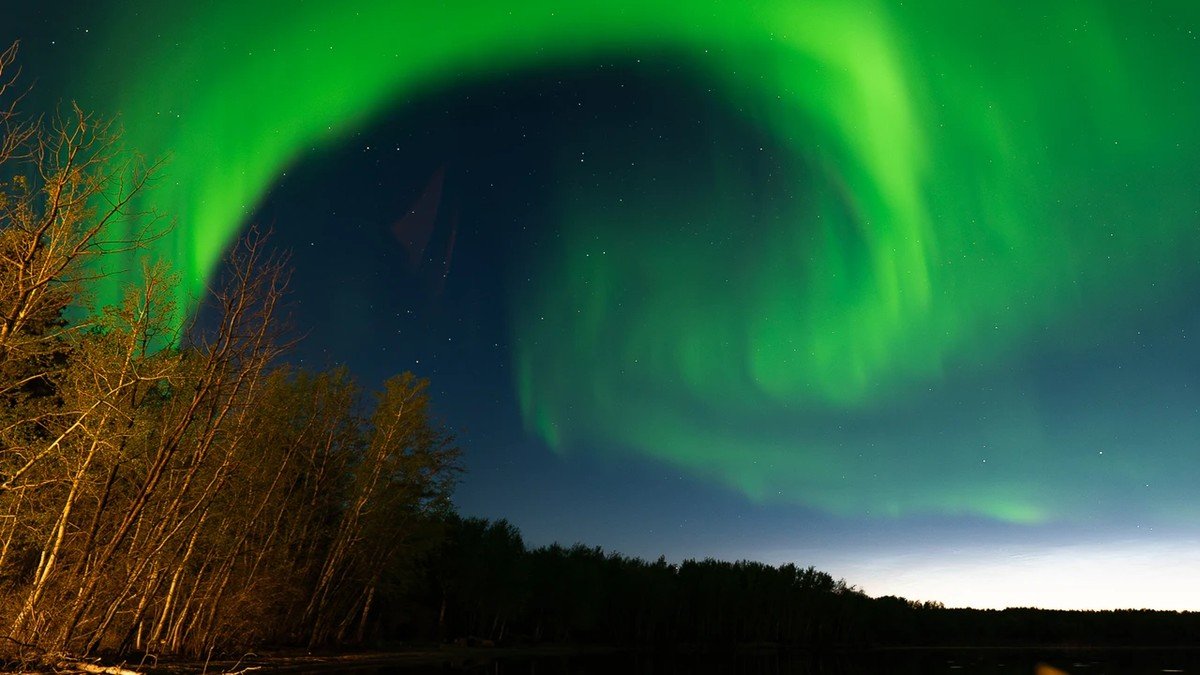
A fast-moving coronal mass ejection (CME) erupted from the Sun and collided with Earth's magnetic field, triggering a Severe (G4) geomagnetic storm that painted night skies with breathtaking auroral displays across unusual mid-latitude regions. Forecasters at the U.S. National Oceanic and Atmospheric Administration's (NOAA) Space Weather Prediction Center in Boulder, Colorado, tracked the magnetized plasma cloud traveling at speeds exceeding 1.5 million miles per hour (2.4 million km/h).
The solar tempest originated from active sunspot region AR3848, which unleashed an intense X1.8-class solar flare aimed directly along the Sun-Earth line. Upon striking the DSCOVR and ACE solar wind monitoring satellites positioned one million miles upstream at Lagrange Point 1, instruments registered a sharp southward orientation of the interplanetary magnetic field—the optimal magnetic coupling needed to energize Earth's upper atmosphere.
High-Velocity Coronal Mass Ejection Slams Earth's Magnetosphere
As geomagnetic indices surged to Kp 8, the auroral oval expanded dramatically equatorward. Skywatchers captured vivid curtains of crimson, violet, and emerald light across more than 35 U.S. states, stretching from Maine and the Great Lakes down to Texas, Arizona, and central California. Across the Atlantic and Eurasia, brilliant northern lights illuminated skies over the United Kingdom, Germany, France, northern Italy, and Hokkaido in Japan.
Ahead of the impact, NOAA issued advance G4 alerts to critical infrastructure operators, including Federal Emergency Management Agency (FEMA) officials and North American power grid coordinators, as hurricane recovery crews worked across the southeastern United States. High-voltage transmission utilities implemented reactive power safeguards to absorb geomagnetically induced currents.
“This high-velocity coronal mass ejection produced severe G4 geomagnetic storm conditions, pushing the auroral oval far into mid-latitude regions while keeping grid operators on high alert.” — Shawn Dahl, Service Coordinator at the NOAA Space Weather Prediction Center
Power Grid Resilience and Solar Cycle 25 Peak Activity
Commercial airlines rerouted select polar transcontinental flights to lower latitudes to avoid high-frequency radio blackouts and elevated radiation exposure, while satellite operators monitored increased atmospheric drag on low-Earth orbit constellations. Despite the intensity of the magnetic disturbance, utility regulators and aerospace agencies confirmed that electrical grids and global navigation networks operated without major disruptions.
Solar physicists noted that the October event underscores the heightened volatility of Solar Cycle 25, which has reached its solar maximum phase with sunspot numbers surpassing initial multi-agency projections. Following the historic G5 extreme geomagnetic storm of May 2024, researchers expect frequent coronal mass ejections and aurora opportunities to persist through 2025.
Frequently Asked Questions
What caused the Severe G4 geomagnetic storm and widespread auroras?
An X1.8-class solar flare from sunspot region AR3848 launched a fast coronal mass ejection traveling over 1.5 million mph directly into Earth's magnetosphere.
Did the G4 solar storm cause any major power grid or satellite failures?
No major outages occurred, as early warnings from NOAA's Space Weather Prediction Center allowed power grid and satellite operators to activate protective measures.



Comments (0)
Log in to join the discussion.