

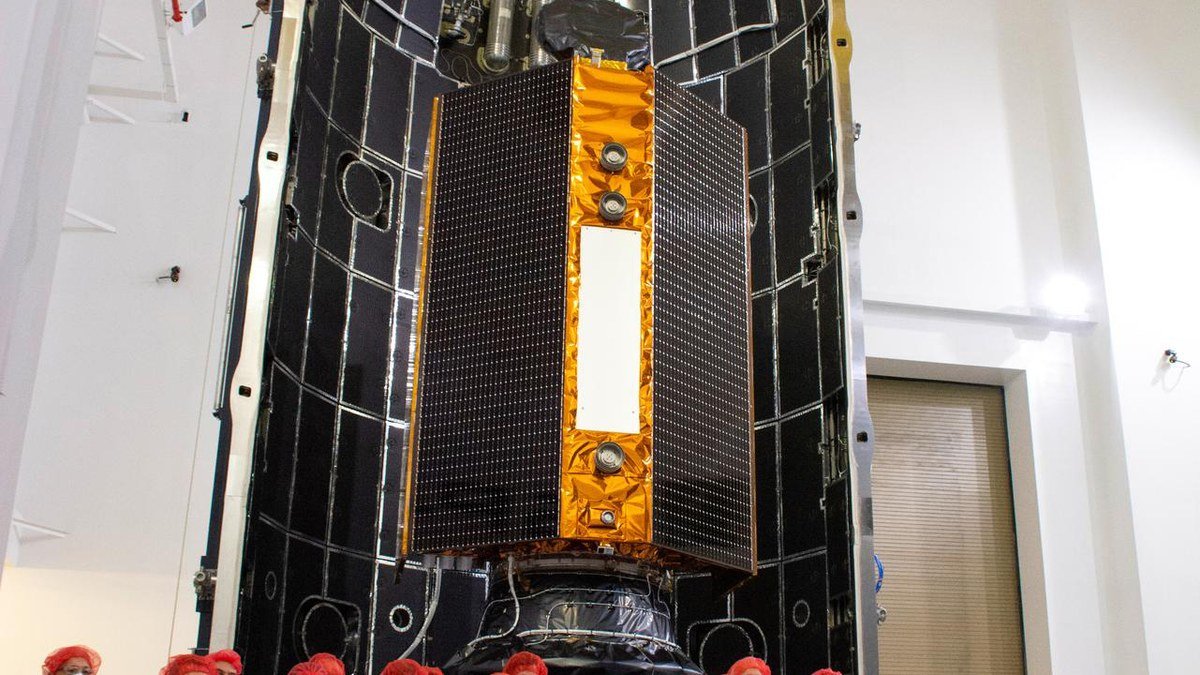
The Mohammed Bin Rashid Space Centre (MBRSC) in Dubai has officially completed the final phase of environmental and systems readiness testing for MBZ-SAT, the Arab world's most technologically advanced commercial Earth observation satellite. Following rigorous thermal vacuum, mechanical vibration, and electromagnetic compatibility trials conducted in collaboration with international test facilities, the 750-kilogram spacecraft has been certified for shipment ahead of its scheduled launch aboard a SpaceX Falcon 9 rocket from Vandenberg Space Force Base in California.
Named in honor of UAE President Sheikh Mohamed bin Zayed Al Nahyan, MBZ-SAT measures three meters by five meters and represents the fourth Earth observation satellite wholly designed and developed by Emirati engineers at MBRSC, following DubaiSat-1, DubaiSat-2, and the landmark KhalifaSat launched in 2018. Once deployed into a sun-synchronous low-Earth orbit at an altitude of roughly 500 kilometers, the spacecraft will serve both government agencies and commercial clients worldwide.
Twice the Resolution of KhalifaSat with Automated 24/7 Tasking
Equipped with an ultra-high-resolution optical camera system and an advanced electric propulsion thruster, MBZ-SAT delivers more than double the spatial imaging resolution of KhalifaSat while increasing total daily image production tenfold. The satellite features a fully automated 24/7 ground-station scheduling system and a high-speed X-band downlink capable of transmitting encrypted geospatial data at four times the speed of previous Emirati orbital platforms.
Imagery captured by MBZ-SAT will support urban infrastructure planning, precision agriculture, disaster relief coordination, marine water-quality monitoring, and climate change mitigation across the Middle East and globally. Its onboard artificial intelligence processing unit can autonomously filter cloud cover and prioritize high-urgency environmental anomalies before transmitting raw frames to ground receivers in Al Khawaneej.
“MBZ-SAT represents a quantum leap for the UAE's domestic aerospace industry, with over ninety percent of its mechanical structures manufactured by Emirati companies.”
Over 90 Percent Emirati-Built Mechanical Structures
Beyond its scientific capabilities, MBZ-SAT serves as a cornerstone of the UAE's National Space Strategy 2030 to localize advanced manufacturing. MBRSC partnered with private Emirati industrial firms—including Strata Manufacturing, EPI, Falcon Group, and Halcon—to produce more than 90 percent of the satellite's precision aluminum and composite mechanical structures and nearly 50 percent of its electronic wiring harnesses and power modules.
With MBZ-SAT now cleared for launch preparations, MBRSC is simultaneously advancing the development of the radar-imaging Sirb satellite constellation, the Emirates Mission to the Asteroid Belt (EMA), and the Emirates Airlock module for NASA's Lunar Gateway station, cementing the UAE's status as a premier global hub for space science and commercial aerospace engineering.
Comments (0)
Log in to join the discussion.