

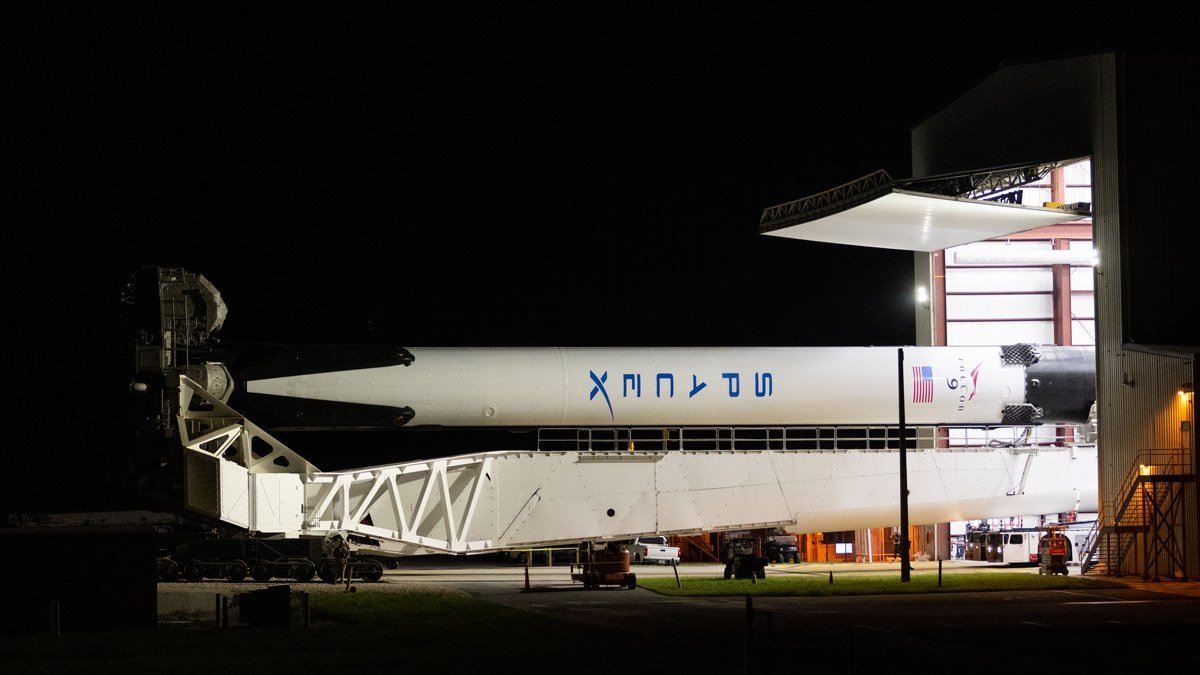
Mission managers from NASA and SpaceX officially granted "go" status on Friday night for the ninth operational commercial crew rotation mission to the International Space Station (ISS). Following a comprehensive Launch Readiness Review and the successful completion of a pre-launch static fire test, the Falcon 9 rocket and Crew Dragon Freedom spacecraft are set to lift off from Space Launch Complex 40 (SLC-40) at Cape Canaveral Space Force Station in Florida on Saturday afternoon.
The clearance comes just hours after Hurricane Helene swept across the Gulf Coast and northern Florida, prompting launch engineers to temporarily shelter the integrated Falcon 9 and Dragon stack inside SpaceX's horizontal integration hangar earlier in the week. Once winds subsided along the Space Coast, crews rolled the rocket back out to the pad, verified all telemetry and propellant systems, and confirmed that coastal weather conditions had improved to a 55 percent favorable forecast for Saturday's instantaneous launch window.
Historic Liftoff from Space Launch Complex 40 and Hurricane Recovery
Saturday's liftoff will make aerospace history as the very first crewed orbital launch conducted from Space Launch Complex 40. Historically used by the U.S. Air Force for Titan rockets and later by SpaceX for robotic cargo missions and commercial satellite deployments, SLC-40 recently underwent an extensive multi-year upgrade. Engineers constructed a crew access tower, a sleek crew access arm, and a high-speed emergency slidewire escape system to provide SpaceX with dual-pad human spaceflight redundancy alongside Kennedy Space Center's Pad 39A.
Adding launch capability at SLC-40 proved essential this autumn because Pad 39A was simultaneously being configured for NASA's heavy-lift Falcon Heavy Europa Clipper planetary science mission. Ground teams conducted multiple emergency egress drills and propulsive checks over the past week to ensure the newly certified pad infrastructure met NASA's stringent human-rating requirements.
“After riding out Hurricane Helene safely inside the hangar, the Falcon 9 rocket and Dragon Freedom spacecraft are in excellent shape on Pad 40, and our teams are go for launch.”
Reconfigured Two-Person Crew to Bring Starliner Astronauts Home
Unlike standard four-person commercial crew rotations, Crew-9 is launching with a streamlined two-person crew: NASA astronaut Nick Hague, serving as mission commander, and Roscosmos cosmonaut Aleksandr Gorbunov, serving as mission specialist. Hague, a U.S. Space Force colonel, is making his third flight into space and becomes the first active-duty Space Force Guardian to launch on a spacecraft since the service branch's establishment.
The remaining two seats aboard Dragon Freedom have been intentionally left vacant and ballasted with specialized cargo and custom-fitted spacesuits for NASA astronauts Butch Wilmore and Suni Williams. Wilmore and Williams arrived aboard the orbital outpost in June on Boeing's Starliner Crew Flight Test and were reassigned to Expedition 71/72 after NASA opted to return the Starliner capsule uncrewed earlier in September. Once Hague and Gorbunov dock with the Harmony module's forward port, the quartet will conduct over 200 scientific experiments before returning to Earth together in February.
Comments (0)
Log in to join the discussion.