

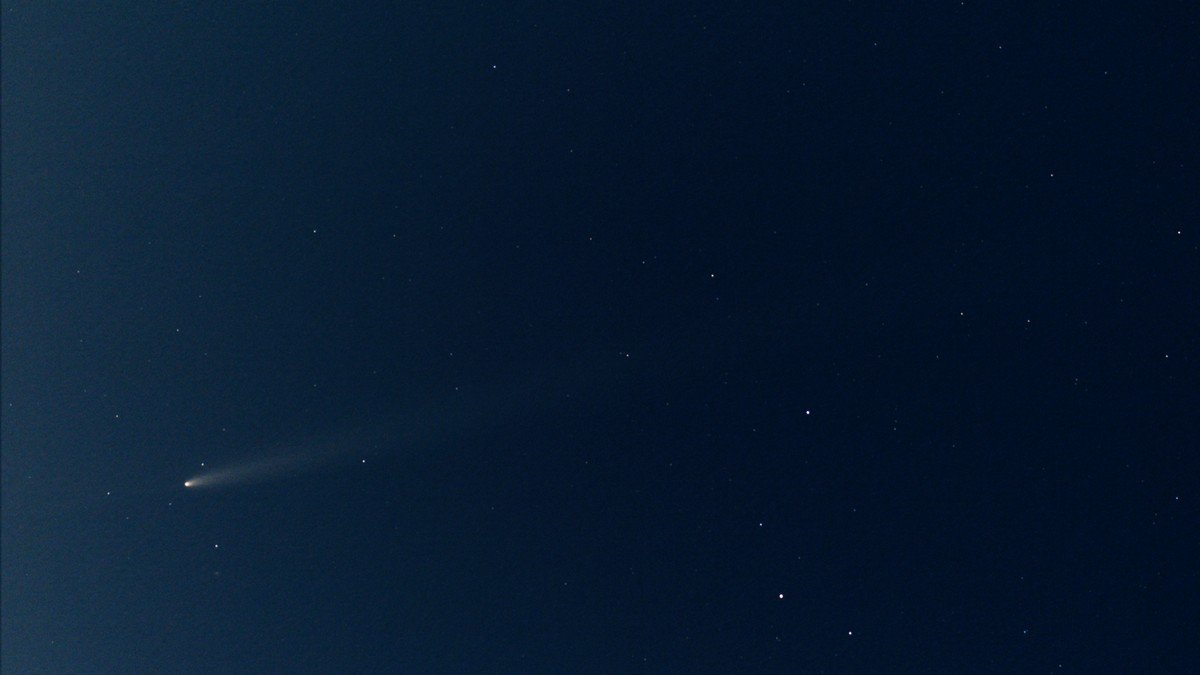
Astronomers and skywatchers around the world breathed a collective sigh of relief this weekend as Comet C/2023 A3 (Tsuchinshan-ATLAS) successfully survived perihelion—its closest and most hazardous approach to the Sun—without fragmenting. Passing at a distance of 0.391 astronomical units (approximately 58.6 million kilometers, or roughly the orbital distance of Mercury), the ancient Oort Cloud visitor endured intense solar radiation and gravitational tidal forces to emerge with a brilliant, tightly condensed nucleus and a sweeping dust tail.
Independently discovered in early 2023 by astronomers at China's Purple Mountain Observatory (Tsuchinshan) and the Asteroid Terrestrial-impact Last Alert System (ATLAS) telescope in Sutherland, South Africa, C/2023 A3 is making its first inner-solar-system passage in roughly 80,000 years. Earlier in the summer, some researchers had raised concerns that the comet's volatile icy nucleus might disintegrate before reaching perihelion, a fate common among dynamically new Oort Cloud comets.
Spectacular Pre-Dawn Views From Earth and Orbit
Instead, photometric observations compiled by the International Astronomical Union's Minor Planet Center and global observer networks show the comet brightening steadily to around magnitude +2.0—comparable to the stars of the Big Dipper—even while low in the bright morning twilight. Observers across the Southern Hemisphere and tropical latitudes, followed this weekend by mid-northern latitudes, have photographed a vivid golden tail spanning more than five degrees through binoculars and telephoto lenses.
Aboard the International Space Station, NASA astronauts Matthew Dominick and Don Pettit captured striking time-lapse sequences of Comet Tsuchinshan-ATLAS rising above Earth's atmospheric airglow just ahead of the Sun. From orbit, free of atmospheric extinction, the comet's coma and dual dust-and-ion structure appeared remarkably sharp.
“Surviving perihelion intact means Comet Tsuchinshan-ATLAS is now poised to become the brightest and most spectacular naked-eye comet visible from Earth in more than a decade.”
Forward-Scattering Peak and October Evening Visibility
As C/2023 A3 swings between the Sun and Earth during the first week of October, it will enter the field of view of the LASCO C3 coronagraph aboard the joint ESA/NASA Solar and Heliospheric Observatory (SOHO). Around October 8 to 10, the comet's dust tail will align nearly directly between the Sun and Earth, triggering an optical phenomenon known as forward scattering of sunlight that could temporarily boost its brightness to magnitude -1 or brighter.
Following its closest approach to Earth on October 12 at a safe distance of 0.47 astronomical units (70.6 million kilometers), Comet Tsuchinshan-ATLAS will transition rapidly into the western evening sky after sunset, offering Northern Hemisphere observers their best dark-sky viewing window since Comet NEOWISE in 2020.


Comments (0)
Log in to join the discussion.