

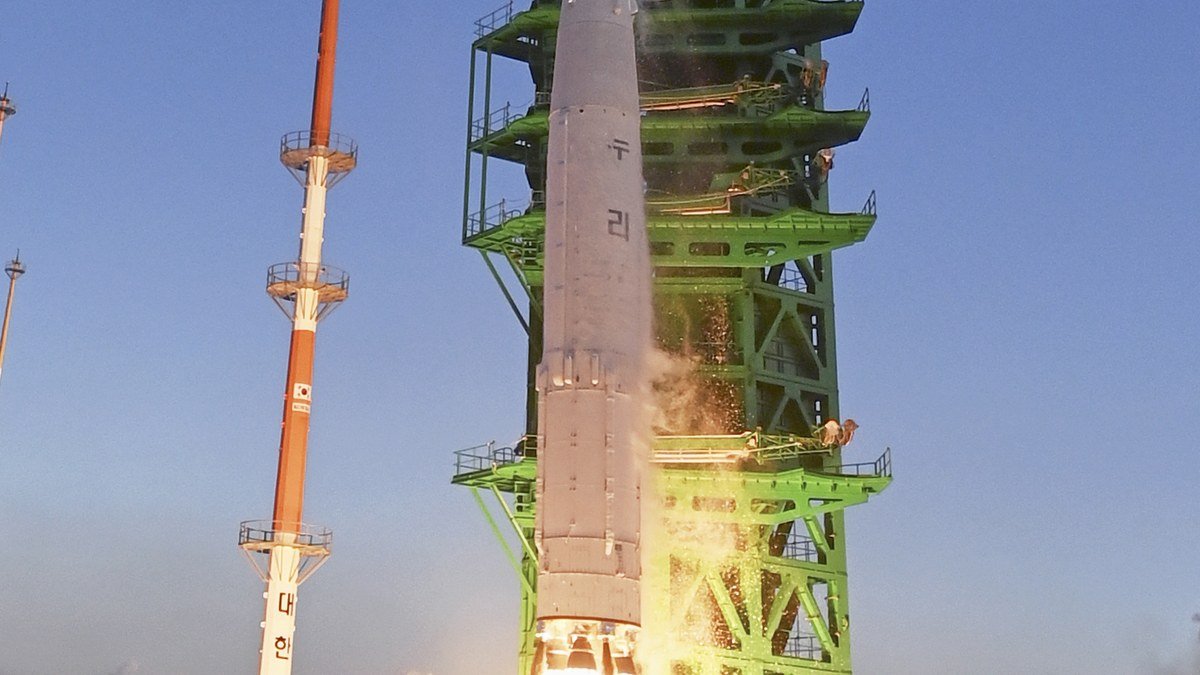
South Korea's newly established national space agency, the Korea Aerospace Administration (KASA), and defense-and-space prime contractor Hanwha Aerospace have advanced a joint technical agreement to accelerate the development of the Next-Generation Launch Vehicle (KSLV-III) and indigenous reusable rocket propulsion systems. Meeting with aerospace leaders in Sacheon and Daejeon, KASA Administrator Yoon Young-bin outlined a dual-track strategy combining near-term heavy-lift orbital transport with reusable liquid-methane booster architectures.
Launched in May 2024 as South Korea's counterpart to NASA, KASA is spearheading a 2.01-trillion-won ($1.5 billion) national program together with the Korea Aerospace Research Institute (KARI) and system integrator Hanwha Aerospace. The KSLV-III rocket is designed to deliver more than three times the payload capacity of the current Nuri (KSLV-II) launcher, capable of placing a 1.8-ton spacecraft into lunar transfer orbit or 10 tons into low-Earth orbit.
Transitioning From Nuri KSLV-II to Staged-Combustion Reusable Boosters
Under the updated propulsion roadmap, KARI and Hanwha Aerospace are developing a cluster of five 100-ton-thrust staged-combustion cycle engines for the first stage and two 10-ton-thrust multi-ignition engines for the upper stage. Simultaneously, KASA has prioritized research into deep-throttling liquid oxygen and methane engines, grid-fin aerodynamic guidance, and vertical landing legs required to recover and refly first-stage boosters.
Resolving intellectual property and joint technology-transfer frameworks between KARI and Hanwha Aerospace has been a central priority for KASA, ensuring that private Korean suppliers gain full commercial manufacturing rights to compete against global launch providers.
“Developing indigenous reusable launch vehicle technology in partnership with private industry is essential for South Korea to become one of the world's top five space powers.”
Targeting the 2032 Lunar Lander and Global Commercial Launch Market
The KSLV-III program schedules its maiden test flight in 2030, a second verification launch in 2031, and a landmark third mission in 2032 to land an indigenous South Korean robotic explorer on the surface of the Moon. In parallel, Hanwha Aerospace is leading the fourth, fifth, and sixth commercial flights of the Nuri rocket through 2027.
Backed by the 'Aerospace Trio' cluster connecting Gyeongnam (manufacturing), Jeonnam (Naro Space Center launch complex), and Daejeon (R&D), South Korea aims to lower its per-kilogram orbital launch costs to under $1,000 and capture 10 percent of the global space industry market by 2045.
Comments (0)
Log in to join the discussion.