

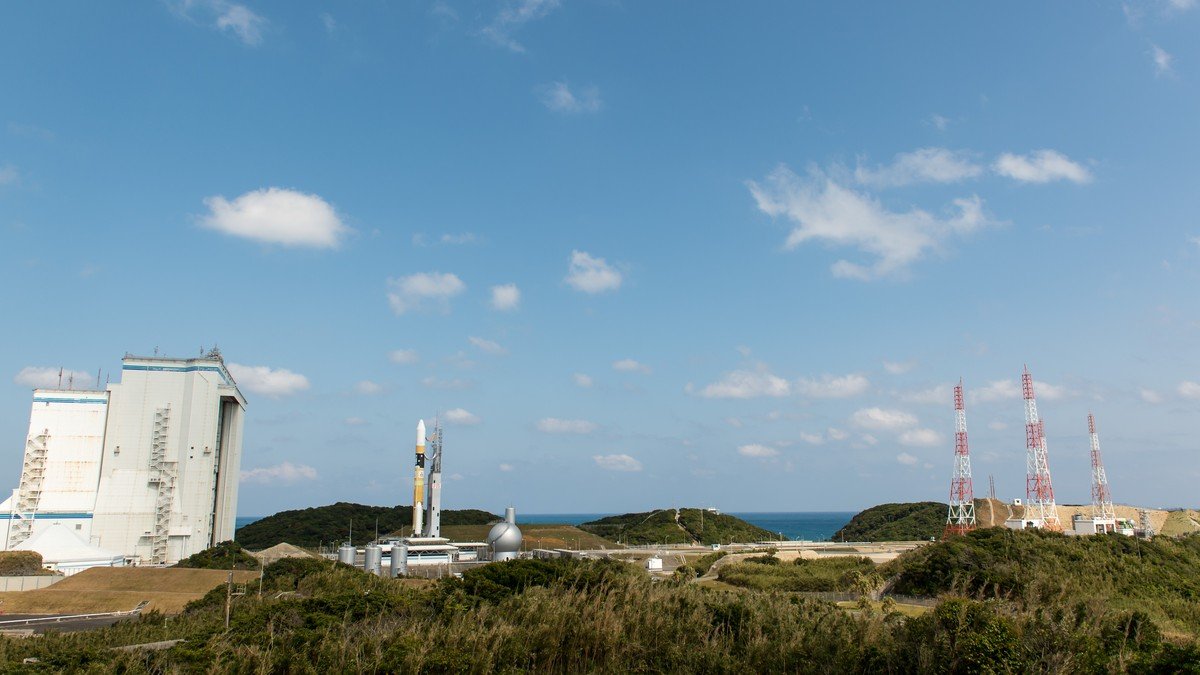
The Japan Aerospace Exploration Agency (JAXA) and prime contractor Mitsubishi Heavy Industries (MHI) successfully rolled out the H3 Launch Vehicle Flight 4 (H3 F4) to Launch Pad 2 at the Yoshinobu Launch Complex on Tanegashima Island on September 22, 2026. The milestone initiates final countdown procedures for a critical national security mission.
Encapsulated within the vehicle's payload fairing is the Ministry of Defense's X-band defense communications satellite, designated Kirameki-3 (DSN-3). Once placed into geostationary orbit, the spacecraft will provide encrypted, high-bandwidth communication links connecting Japan Self-Defense Forces (JSDF) units deployed across the maritime, air, and ground domains.
Kirameki-3 Mission Bolsters Japan's Military Communications Grid
Flight 4 employs the powerful H3-24L configuration, featuring two core-stage LE-9 liquid hydrogen/liquid oxygen engines, four strap-on solid rocket boosters (SRB-3), and an elongated 4-meter-wide fairing. The vehicle stands 63 meters tall and generates approximately 5,700 kilonewtons of liftoff thrust.
Engineers from JAXA and MHI conducted thorough functional rehearsals following the rocket's smooth 500-meter transit from the Vehicle Assembly Building (VAB). Propellant loading tests, cryogenic fluid chill-downs, and electrical avionics checks confirmed that all launch vehicle subsystems are operating within nominal engineering parameters.
“Flight 4 is a pivotal milestone that demonstrates the operational reliability of the H3 rocket while safeguarding Japan's sovereign space-based communications architecture.”
Operational Maturity of the LE-9 Cryogenic Engine and H3 Architecture
This flight marks the fourth launch of Japan's next-generation flagship space vehicle, which was introduced to replace the venerable H-IIA workhorse while reducing launch costs by nearly 50%. Following back-to-back orbital successes on Flights 2 and 3, Flight 4 represents the full transition of the H3 platform into operational service.
Beyond safeguarding sovereign security capabilities, a flawless orbital deployment will reinforce MHI's position in the global commercial launch market. With an international backlog that includes multiple commercial satellite constellations and future resupply missions to the Lunar Gateway, Japan's space industry is demonstrating renewed competitive vigor.

Comments (0)
Log in to join the discussion.