

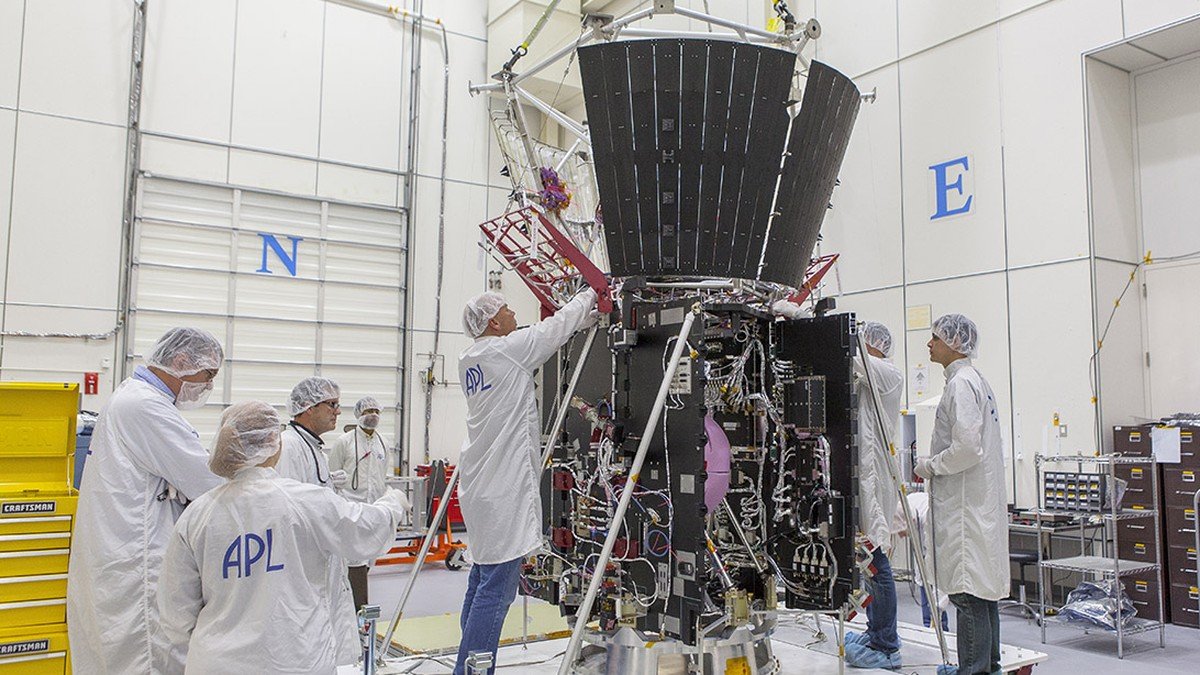
NASA's Parker Solar Probe has successfully completed its 21st close solar approach—known as perihelion—streaking through the blazing outer atmosphere of our star at an astonishing speed of 394,736 miles per hour (635,266 kilometers per hour).
Operated by the Johns Hopkins Applied Physics Laboratory (APL) in Laurel, Maryland, the historic spacecraft brought its scientific instruments to within just 4.51 million miles (7.26 million kilometers) of the solar surface, enduring radiation conditions unmatched in the history of spaceflight.
Braving Extreme Temperatures Inside the Solar Atmosphere
During the high-speed encounter, Parker was shielded by its cutting-edge 4.5-inch-thick carbon-composite thermal protection shield, which withstood exterior temperatures soaring above 2,500 degrees Fahrenheit (1,400 degrees Celsius) while maintaining the instruments behind it at a comfortable room temperature of 85 degrees.
The probe's four instrument suites—FIELDS, SWEAP, WISPR, and IS☉IS—operated autonomously throughout the pass, capturing vital data on magnetic switchbacks, plasma turbulence, and the mysterious heating mechanism that causes the solar corona to burn hundreds of times hotter than the surface below.
“Parker Solar Probe continues to surpass all engineering expectations. By flying directly through the origin zone of the solar wind, we are uncovering secrets of solar physics that eluded scientists for generations.”
The Final Venus Slingshot and the Grand Finale
Mission controllers confirmed that Parker emerged from behind the Sun in excellent health, transmitting a radio beacon tone confirming all subsystems and primary computer architectures are operating nominally.
This 21st flyby sets the stage for a critical milestone in November 2024, when the spacecraft will perform its seventh and final gravity assist flyby of Venus, bleeding off orbital energy to propel Parker to an astonishing 430,000 mph within just 3.8 million miles of the Sun in December.

Comments (0)
Log in to join the discussion.