

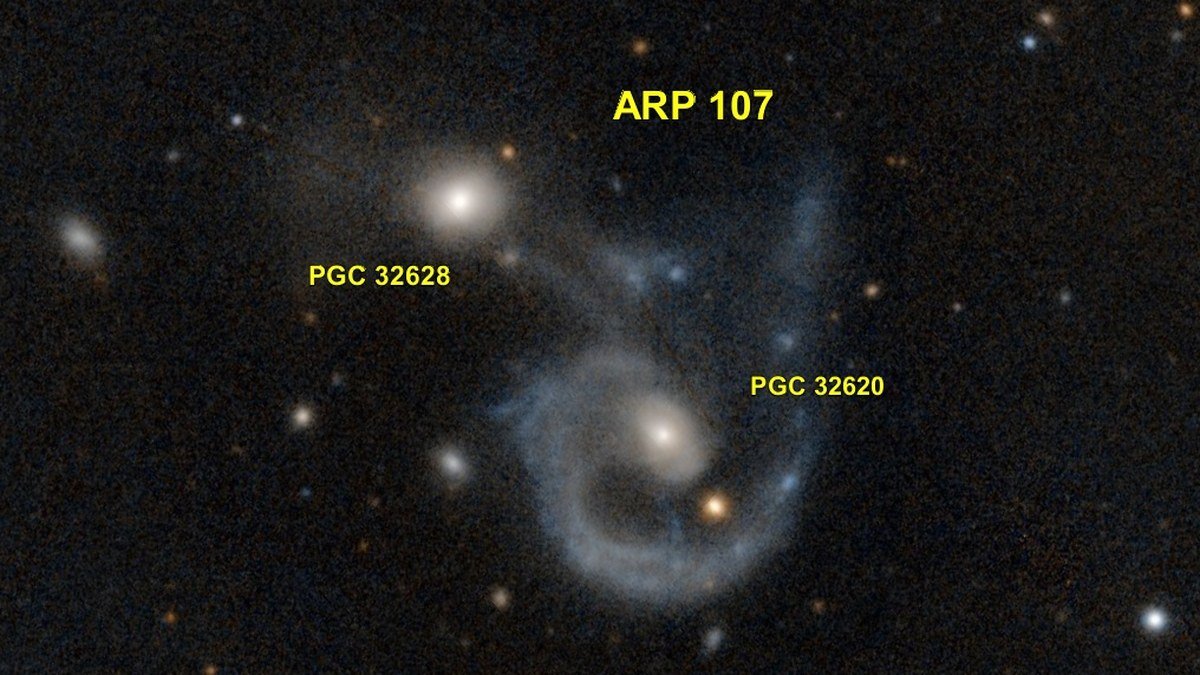
Astronomers at NASA, the European Space Agency (ESA), and the Canadian Space Agency (CSA) released breathtaking composite observations on Monday from the James Webb Space Telescope, revealing an ethereal celestial structure dubbed the 'cosmic smile' carved by a violent galactic collision designated Arp 107.
Located approximately 465 million light-years away in the constellation Leo Minor, Arp 107 comprises two interacting galaxies locked in an intricate gravitational embrace that has stretched stellar clusters and molecular clouds across tens of thousands of light-years.
Gravitational Choreography Across 465 Million Light-Years
The larger system is an active Seyfert galaxy featuring a supermassive black hole at its core, while the smaller intruder galaxy sliced through its periphery millions of years ago, unleashing immense tidal forces that pulled out a curving celestial arc of gas and glowing dust resembling an infectious grin.
The new view combines data from Webb's Near-Infrared Camera (NIRCam) and Mid-Infrared Instrument (MIRI). NIRCam captured the sharp distribution of older stars within both galaxies, while MIRI cut through dense interstellar smoke to illuminate glowing polycyclic aromatic hydrocarbons and newborn starburst clusters.
“Webb allows us to dissect the Anatomy of galactic collisions in unprecedented detail, showing how violent mergers compress gas clouds to ignite new generations of stars.”
Infrared Synthesis of Starbirth Amid Cosmic Destruction
Unlike head-on collisions that completely obliterate galactic architecture, Arp 107 represents an off-center grazing collision, preserving the ring structure of the host galaxy while pulling out a delicate bridge of luminous material.
Astrophysicists noted that observing Arp 107 provides valuable predictive insights into the distant fate of our own Milky Way galaxy, which is destined to merge with the neighboring Andromeda galaxy in approximately four billion years.

Comments (0)
Log in to join the discussion.