

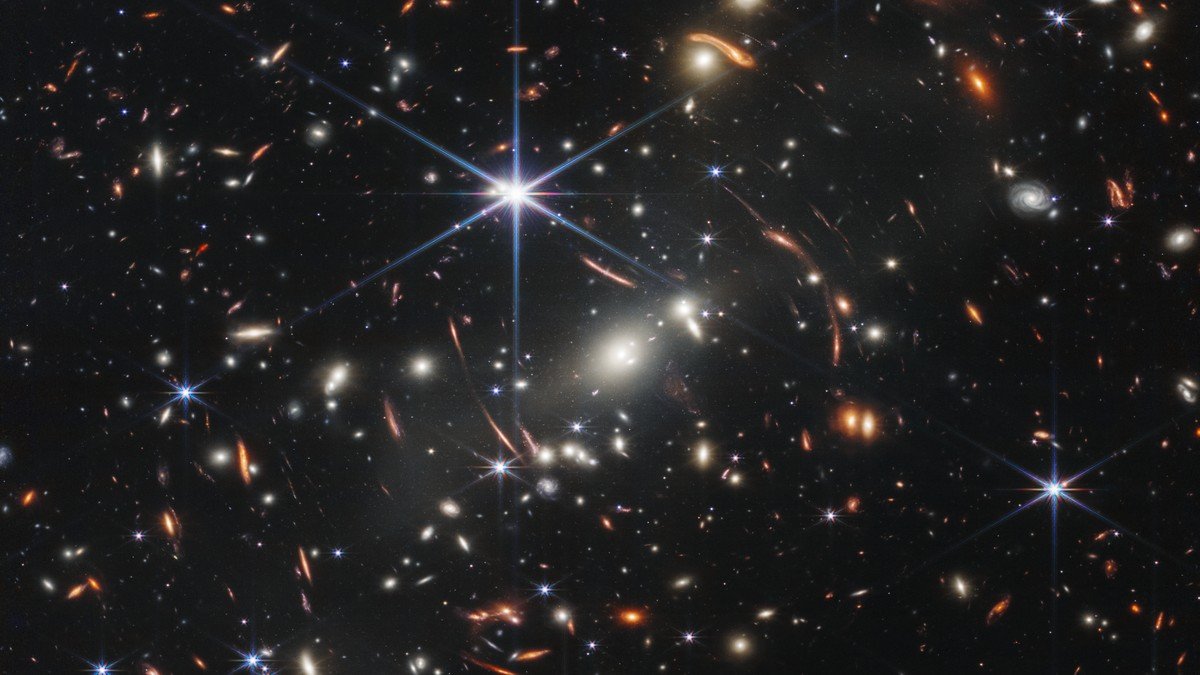
An international consortium of astrophysicists utilizing NASA's James Webb Space Telescope (JWST) published peer-reviewed findings in Nature Astronomy on September 23, 2026, confirming the spectroscopic verification of RUBIES-EGS-QG-1, one of the most massive quiescent—or 'dead'—galaxies ever observed in the early universe. Detected at a cosmological redshift of z = 4.9, the galaxy is seen as it existed a mere 1.1 billion years after the Big Bang, defying prevailing theoretical timelines of galactic growth.
Data collected via Webb's Near-Infrared Spectrograph (NIRSpec) instrument revealed that RUBIES-EGS-QG-1 possessed a stellar mass exceeding 100 billion times that of our Sun. Astonishingly, this immense mass is compressed into an effective physical radius of approximately 3,200 light-years—scarcely one-fifth the dimensions of the modern Milky Way. The resulting stellar density is several hundred times higher than any galaxy in the contemporary local universe.
NIRSpec Spectroscopy Verifies Extreme Redshift and Quenched Stellar Core
Spectroscopic analysis demonstrated that star formation within RUBIES-EGS-QG-1 had completely ceased hundreds of millions of years prior to the epoch of observation. The galaxy's spectral energy distribution revealed pronounced Balmer absorption lines and a sharp 4000-Angstrom break, unambiguous signatures indicating that its stellar population is composed almost entirely of older, evolved stars that formed in a violent, hyper-efficient starburst when the universe was only 600 to 800 million years old.
The discovery delivers a profound shock to standard Lambda-Cold Dark Matter (LCDM) cosmological simulations. Under orthodox models, dark matter halos during this cosmic dawn were thought to lack the gravitational potential to assemble such titanic stellar populations so swiftly, let alone violently quench starbirth without subsequent cold gas accretion reigniting combustion.
“Finding a galaxy this massive and already completely inactive so early in cosmic time is akin to meeting a fully grown, retired adult in kindergarten. It forces us to rethink how quickly gas can convert into stars and how supermassive black holes shut off that process.”
Cosmological Enigma: What Strangled Star Formation in the Cosmic Dawn?
Researchers hypothesize two primary physical mechanisms behind the premature cessation of starbirth. The leading candidate is violent feedback from an active galactic nucleus (AGN)—a rapidly growing central supermassive black hole whose relativistic radiation jets and winds blew the galaxy's reservoir of cool molecular gas into intergalactic space. Alternatively, an extreme burst of star formation may have depleted the cold hydrogen reservoir through runaway thermal feedback.
The confirmation of RUBIES-EGS-QG-1 provides powerful validation of JWST's unique infrared sensitivity, proving capable of analyzing obscured starlight inaccessible to previous space observatories like Hubble. As deep spectroscopic surveys continue across the Extended Groth Strip, astronomers anticipate cataloging additional early dead galaxies to rewrite the foundational textbooks on cosmic structure formation.

Comments (0)
Log in to join the discussion.