

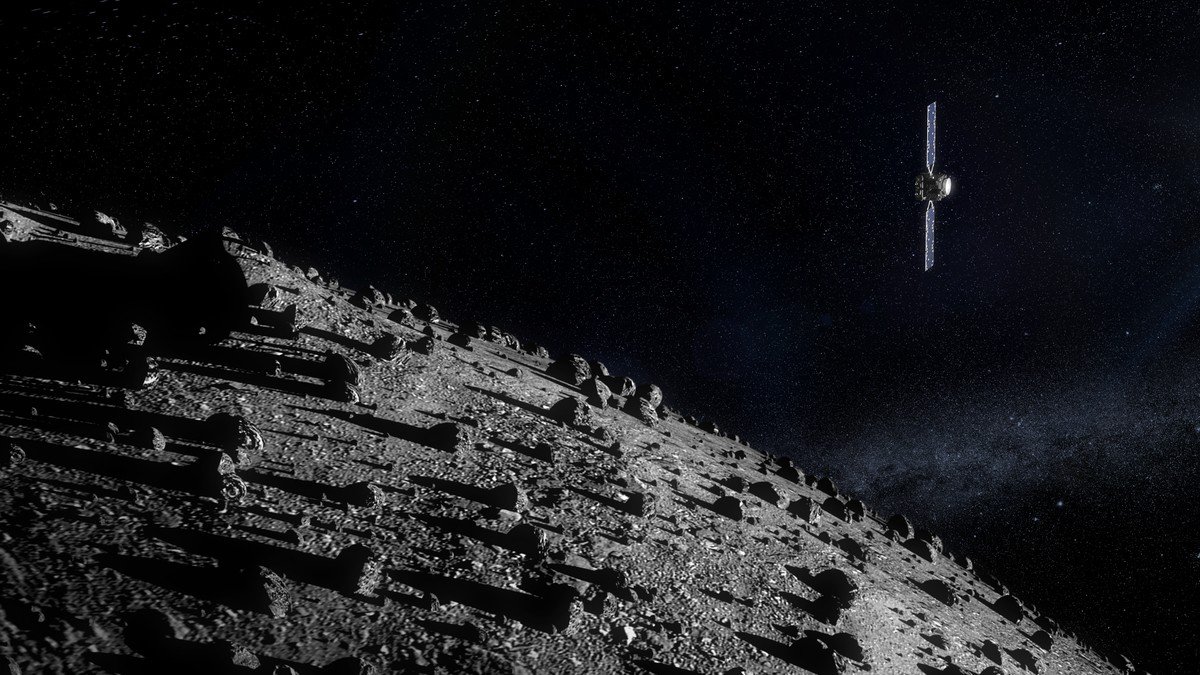
The European Space Agency (ESA) has completed final launch preparations and electrical checkouts for its flagship Hera planetary defense spacecraft at Cape Canaveral Space Force Station in Florida. The advanced deep-space probe has been fueled with hydrazine propellant and cleared for encapsulation within a SpaceX Falcon 9 payload fairing ahead of its scheduled launch window.
Hera represents Europe's primary contribution to an international planetary defense initiative aimed at safeguarding Earth from potential asteroid impacts. The mission is designed to rendezvous in late 2026 with the binary near-Earth asteroid system consisting of the 780-meter primary body Didymos and its 150-meter orbiting moonlet, Dimorphos.
Forensic Survey of Dimorphos Following NASA's Kinetic Deflection
The spacecraft will perform an exhaustive post-impact forensic investigation of Dimorphos, which was deliberately struck in September 2022 by NASA's Double Asteroid Redirection Test (DART) kinetic impactor. While ground-based telescopes confirmed that DART altered Dimorphos's orbital period by 32 minutes, critical questions regarding the collision's physical aftermath remain unanswered.
Equipped with high-resolution optical cameras, thermal infrared imagers, and a scanning lidar system, Hera will closely map the crater carved by DART, quantify the precise volume of excavated asteroid material, and calculate Dimorphos's exact mass and gravitational field with millimeter-scale accuracy.
“Hera is Europe’s contribution to an international planetary defense endeavor. By turning kinetic impact from a single experiment into a well-understood and repeatable defense technique, Hera ensures humanity will be ready should a threatening asteroid ever cross Earth's path.”
CubeSat Deployment and Advanced Radar Probing of Asteroid Interior
In a pioneering operational milestone for deep-space science, Hera will deploy two shoebox-sized CubeSats upon arrival. The 'Juventas' CubeSat carries a low-frequency radar to perform the first-ever subsurface radar tomography of an asteroid's interior, while the 'Milani' CubeSat will analyze mineral composition and cosmic dust dynamics before attempting a gentle touchdown on the boulder-strewn surface.
Astrophysicists emphasize that transforming kinetic deflection from a one-off demonstration into a validated, repeatable planetary defense technique requires ground-truth data on how asteroids absorb kinetic energy. Hera's findings are expected to establish the foundational physics for future celestial hazard mitigation systems.

Comments (0)
Log in to join the discussion.