

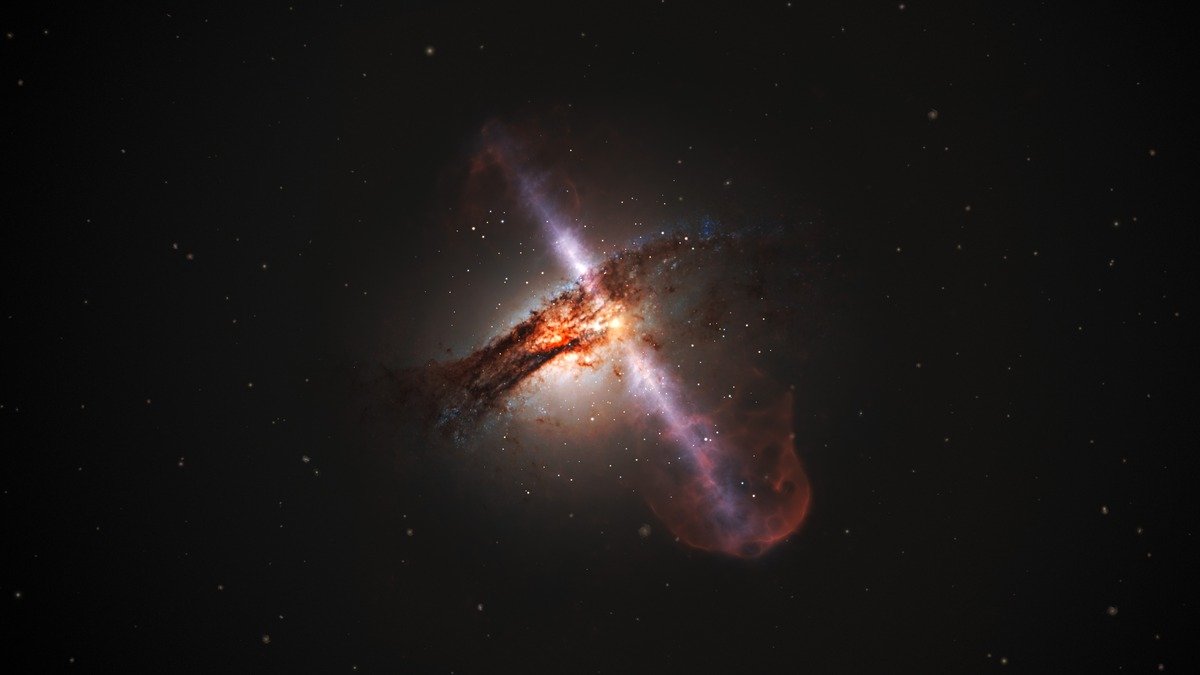
In an observational breakthrough that redefines the known physical boundaries of astrophysical phenomena, an international research consortium has uncovered the largest structure of galactic origin ever documented in the universe. Dubbed Porphyrion, after the mythological Greek giant who warred against the Olympian gods, this monstrous pair of relativistic plasma jets stretches across an astonishing 23 million light-years—equivalent to placing 140 Milky Way galaxies edge-to-edge.
The research, published in the journal Nature and spearheaded by astrophysicists at the California Institute of Technology (Caltech) and Leiden Observatory, reveals that the jets are powered by an active supermassive black hole inside a host galaxy roughly ten times the mass of the Milky Way. Located 7.5 billion light-years from Earth at a redshift of approximately 0.896, the system was observed when the universe was less than half its current age.
A Cosmic Behemoth Spanning 140 Milky Ways
Porphyrion comfortably shatters the previous cosmic scale record held by Alcyoneus, a 16-million-light-year jet system identified by the same research group in 2022. The discovery was enabled by the Low Frequency Array (LOFAR), a state-of-the-art radio telescope network comprising tens of thousands of antennas across eight European nations. Follow-up observations from India's Giant Metrewave Radio Telescope (GMRT) and the W. M. Keck Observatory in Hawaii verified the host galaxy's redshift and energy profile.
Astrophysicists estimate that the supermassive black hole at Porphyrion's core has maintained steady, highly collimated particle accretion for at least a billion years. The total mechanical energy discharged by these relativistic beams is calculated to equal that of trillions of suns, pushing ionized matter and magnetic fields far beyond the gravitational halo of the host galaxy into intergalactic voids.
“Astronomers previously viewed black hole jets as localized phenomena confined to their host clusters. Porphyrion demonstrates that relativistic outflows can rival the scale of the cosmic web itself, fundamentally altering the physics of intergalactic voids.”
Magnetizing the Cosmic Web and Rewriting Galactic Evolution
The sheer physical scale of Porphyrion poses profound challenges to standard cosmological simulations. Prior theoretical models assumed that relativistic jets in the early and middle universe would quickly destabilize and dissipate due to dense intergalactic gas pressure and intense cosmic microwave background radiation. Instead, Porphyrion demonstrates that magnetic coherence can preserve jet integrity across megaparsec scales for geological epochs.
The implications extend to the structural evolution of the cosmos. By injecting immense energy and high-energy particles into intergalactic filaments, mega-jets like Porphyrion likely played a decisive role in distributing primordial magnetic fields and preventing cooling flows across entire galaxy clusters. Astronomers believe thousands of similar undetected mega-jets may have permeated cosmic noon, reshaping our understanding of how the cosmic web was forged.


Comments (0)
Log in to join the discussion.