

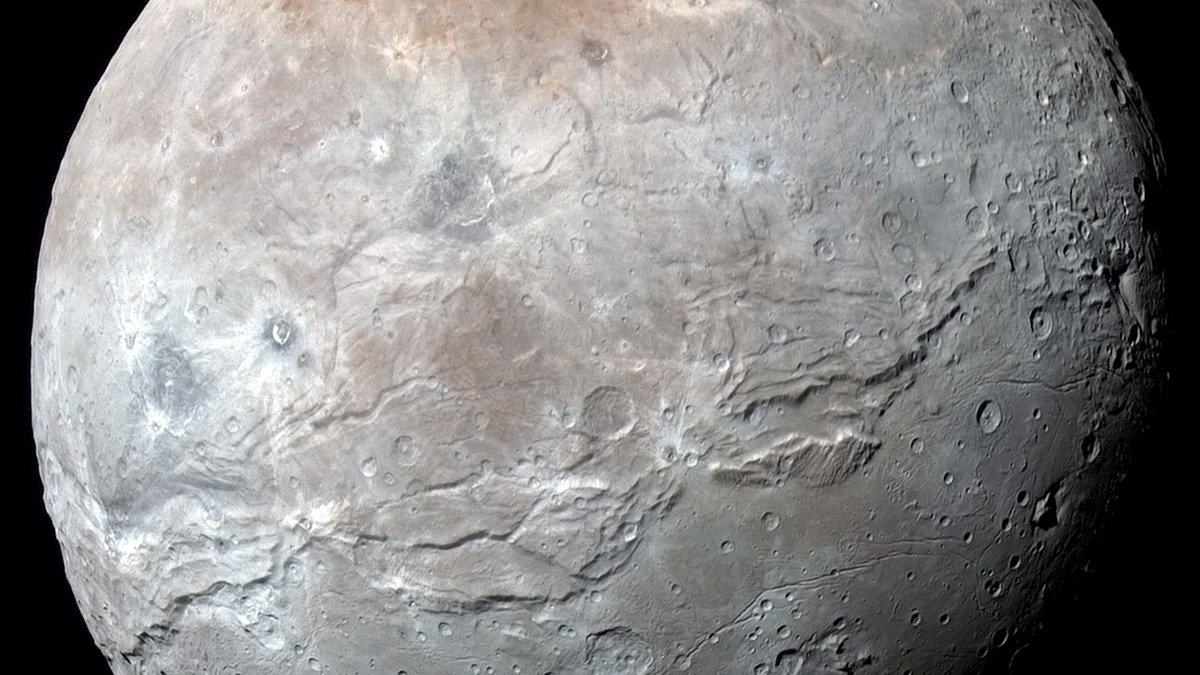
Astronomers utilizing NASA's James Webb Space Telescope have made an unexpected planetary discovery in the distant reaches of the solar system, identifying clear spectroscopic signatures of carbon dioxide ($CO_2$) and hydrogen peroxide ($H_2O_2$) on the frozen surface of Charon, the largest moon of Pluto.
The study, published in Nature Communications by an international research team led by the Southwest Research Institute (SwRI), builds upon earlier baseline data gathered during NASA's New Horizons flyby in 2015. While New Horizons revealed vast water-ice plains and ammonia-rich compounds, its instruments could not detect wavelengths beyond 2.5 microns.
Deciphering Radiolysis and Space Weathering in the Kuiper Belt
Webb's Near-Infrared Spectrograph (NIRSpec) observed Charon across extended infrared wavelengths up to 5.2 microns. These deeper observations revealed that carbon dioxide forms a thin, widespread veneer across the moon's crystalline water-ice crust, likely originating from primordial subsurface volatile reserves that were excavated by asteroid bombardments.
Even more compelling to planetary chemists was the detection of hydrogen peroxide. Laboratory synthesis models confirmed that hydrogen peroxide forms through radiolysis, a process in which energetic solar ultraviolet photons, galactic cosmic rays, and solar wind ions shatter water molecules ($H_2O$), causing energetic hydroxyl radicals to recombine into $H_2O_2$.
“Charon is the only mid-sized Kuiper Belt object for which we have geological context from New Horizons. Webb's infrared sensitivity allows us to unravel chemical processes taking place billions of miles from the Sun.”
Subsurface Reservoirs and the Legacy of the Outer Solar System
The presence of hydrogen peroxide serves as empirical proof of ongoing space weathering in the Kuiper Belt. It demonstrates that even in the frigid temperatures of the outer solar system—hovering around minus 390 degrees Fahrenheit (40 Kelvin)—active chemical transformations continuously sculpt the outer surfaces of icy planetary bodies.
The researchers emphasized that these spectroscopic discoveries transform Charon into a natural laboratory for studying primordial ice chemistry. The findings will assist astronomers interpreting upcoming Webb observations of other trans-Neptunian objects, shedding light on the chemical building blocks that formed the outer planets.

Comments (0)
Log in to join the discussion.