

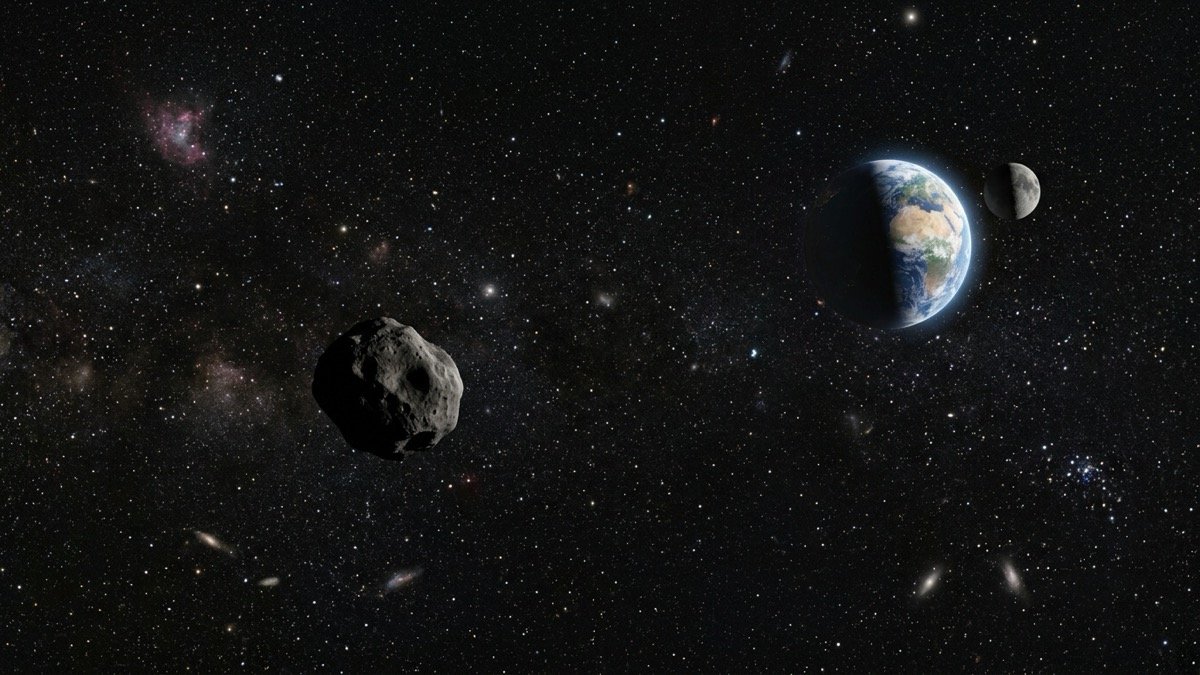
Astronomers from the Universidad Complutense de Madrid have calculated that Earth will gain a temporary second companion in late September. The celestial body, designated 2024 PT5, is an asteroid measuring approximately 33 feet (10 to 11 meters) in diameter that will become gravitationally ensnared by Earth's pull from September 29 until November 25, 2024.
First detected on August 7 by the NASA-funded Asteroid Terrestrial-impact Last Alert System (ATLAS) telescope in Sutherland, South Africa, the object was carefully tracked to determine its precise orbital velocity and origin. Orbital calculations published in the Research Notes of the American Astronomical Society confirm that 2024 PT5 travels at a relatively slow relative speed of approximately 2,200 miles per hour, allowing Earth's gravity to alter its trajectory.
Orbital Mechanics of a Gravitational Capture
Unlike the Moon, which has orbited Earth for more than four billion years, temporary mini-moons fall into two distinct classifications: long-term captures that complete one or more full orbits around the planet, and temporary flyby captures where the object does not complete a closed revolution. 2024 PT5 belongs to the latter category, performing a horseshoe maneuver before breaking free.
Spectroscopic analysis indicates that 2024 PT5 originates from the Arjuna asteroid belt, a secondary belt of near-Earth space rocks that maintain orbits remarkably similar to that of our planet. Intriguingly, follow-up mineralogical modeling suggests the asteroid may represent a fragment of lunar ejecta blasted into space by an ancient impact on the Moon.
“Earth can regularly capture asteroids from the Near-Earth object population and pull them into temporary orbit. 2024 PT5 will undergo a horseshoe-shaped trajectory before re-entering its heliocentric orbit around the Sun.”
Origins in the Arjuna Asteroid Belt
Stargazers hoping to glimpse the mini-moon with the naked eye or backyard telescopes will unfortunately be unable to do so. With an apparent visual magnitude hovering around 22, the object is exceptionally faint and will require professional charge-coupled device (CCD) cameras mounted on research telescopes with apertures of at least 30 inches.
Following its departure in late November, orbital projections indicate that 2024 PT5 will make a subsequent close approach to Earth in January 2025 before departing toward the inner solar system, with its next return anticipated in 2055.
Comments (0)
Log in to join the discussion.