

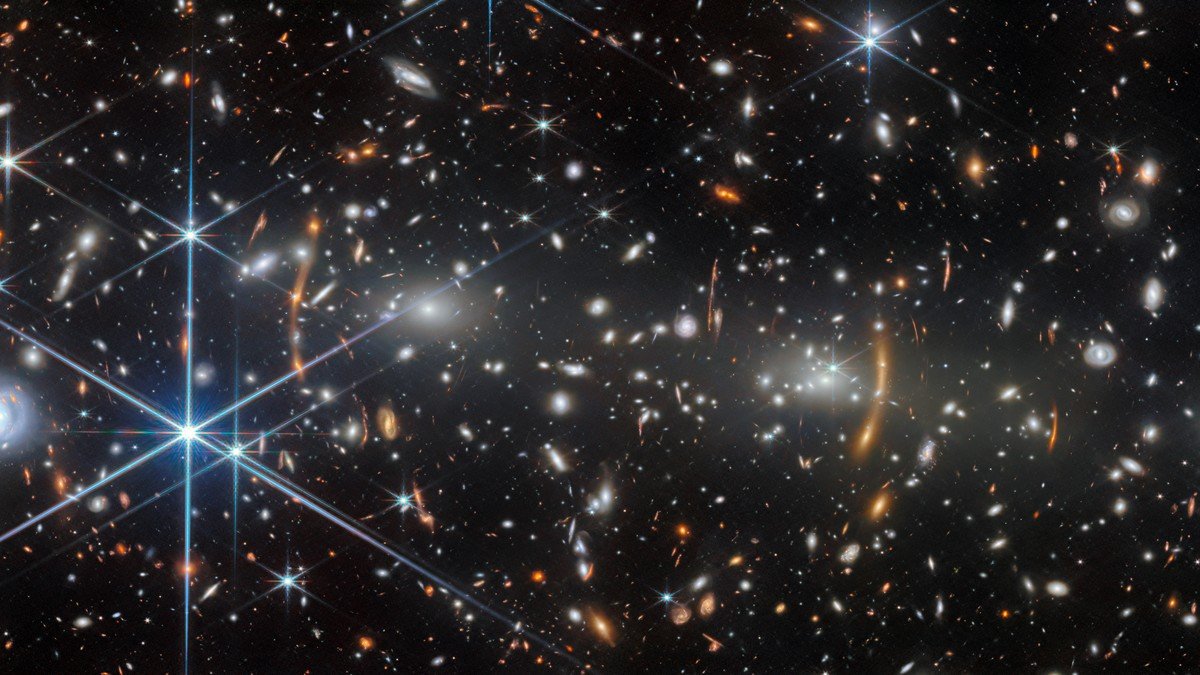
Astronomers employing NASA's James Webb Space Telescope (JWST) have discovered the most distant pair of merging supermassive black holes ever detected in astronomical history. Located within the ancient colliding galaxy system ZS7 at a redshift corresponding to just 740 million years after the Big Bang, the discovery provides unprecedented observational proof of how behemoth black holes assembled during cosmic dawn.
The breakthrough was achieved using the observatory's Near-Infrared Spectrograph (NIRSpec), which dissected the faint infrared emissions escaping the dense interstellar gas shrouding ZS7. By mapping distinct spectral velocity lines, astrophysicists isolated two discrete accretion cores separated by merely a few thousand light-years, each actively devouring infalling matter.
Spectroscopic Detection of Ancient Galactic Collision
For decades, theoretical astrophysicists have struggled to explain how supermassive black holes harboring masses equivalent to hundreds of millions of suns managed to exist within the universe's first billion years. Classical accretion models implied that solitary gas consumption would proceed too slowly to build such colossal masses within that brief timeframe.
The direct observation of this galactic merger demonstrates that rapid hierarchical collisions between progenitor black holes served as the primary accelerator of early cosmic growth.
“Our findings demonstrate that gigantic black holes were already rapidly growing through mergers when the universe was in its cosmic infancy.” — Hannah Übler, Lead Astrophysicist at the University of Cambridge Kavli Institute
Resolving the Primordial Black Hole Growth Paradox
Mass estimations derived from Doppler broadening measurements indicate that one of the black holes contains approximately 50 million solar masses, while its companion possesses comparable mass under a heavily obscured envelope of hot dust.
The international research consortium plans follow-up high-resolution imaging using JWST's Mid-Infrared Instrument (MIRI) and millimeter-wave observations with the ALMA array in Chile to map gravitational wave emission signatures and host galaxy dynamics.
Frequently Asked Questions
Where were the merging supermassive black holes discovered?
They were detected in galaxy system ZS7, dating to just 740 million years after the Big Bang at the dawn of the universe.
Why is this discovery so significant for astrophysics?
It proves that supermassive black holes grew rapidly in the early universe via galactic mergers rather than slow gas accretion alone.
Comments (0)
Log in to join the discussion.