

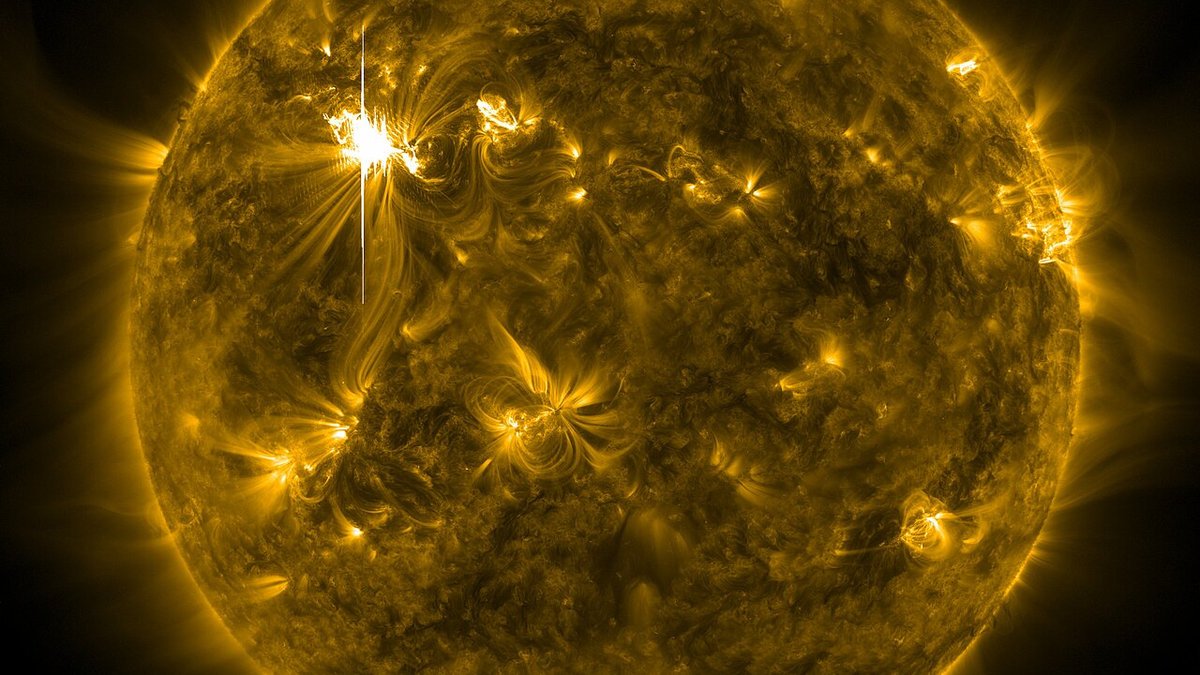
The Sun unleashed its most formidable outburst of the current solar cycle when massive sunspot region AR3842 erupted with an X9.05-class solar flare. Space-based instruments operated by NASA and the National Oceanic and Atmospheric Administration documented the extreme ultraviolet flash, which peaked as the sunspot rotated directly into an Earth-facing alignment.
The intense radiation pulse immediately triggered widespread high-frequency radio blackouts across the Pacific Ocean, maritime shipping lanes, and civil aviation corridors. Ionospheric disturbances temporarily degraded shortwave communications used by emergency response networks and commercial transoceanic aircraft.
Record Eruption at Solar Cycle Maximum and High-Frequency Blackouts
Coronagraph imagery from the joint ESA/NASA SOHO spacecraft confirmed that the flare was accompanied by a powerful, fast-moving coronal mass ejection. A dense cloud of magnetized solar plasma expanded outward at speeds exceeding 1,000 kilometers per second, carving a direct trajectory toward Earth's magnetosphere.
In response to the inbound plasma wave, NOAA's Space Weather Prediction Center issued a G3 (Strong) geomagnetic storm watch. Space weather forecasters alerted electric power transmission operators, commercial satellite constellations, and global navigation satellite systems to monitor for induced ground currents and orbital drag anomalies.
“An X9.0-class flare represents exceptional solar activity near the peak of Solar Cycle 25. We are closely monitoring the resulting coronal mass ejections for potential satellite communications and power grid impacts.” — Space Weather Prediction Center (NOAA)
Coronal Mass Ejections, Power Grid Monitoring, and Aurora Forecast
Solar physicists note that Solar Cycle 25 has exceeded initial consensus predictions in both sunspot frequency and flaring intensity. As the 11-year solar cycle approaches its maximum, magnetic reconnection events in complex delta-class sunspots like AR3842 become substantially more volatile and energetic.
The impending geomagnetic disturbance is expected to push colorful auroral activity to lower latitudes than normal, potentially offering night-sky observers across mid-latitude regions of North America and Europe vivid northern lights. Space agencies continue to track active solar regions as they traverse the solar disk.
Frequently Asked Questions
How strong was the solar flare from sunspot AR3842?
The eruption was classified as an X9.05 flare, making it the most powerful solar flare recorded during Solar Cycle 25.
What alerts did NOAA issue following the eruption?
NOAA's Space Weather Prediction Center issued a G3 (Strong) geomagnetic storm watch due to incoming coronal mass ejections.

Comments (0)
Log in to join the discussion.