

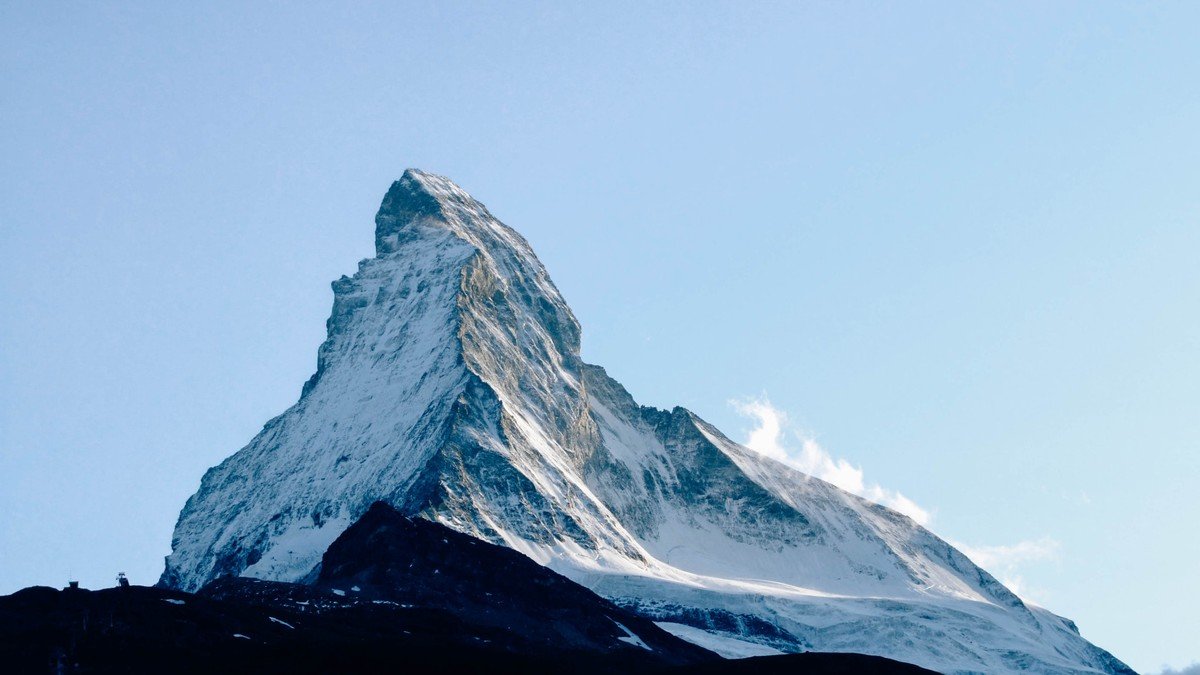
The Swiss Federal Council has formally approved a bilateral border rectification treaty with Italy to redraw sections of their high-alpine national frontier beneath the Matterhorn, after rapid climate-driven glacial melt shifted the natural ridges that legally separate the two nations. Drafted by a joint Italian-Swiss commission in May 2023 and cleared by Bern this weekend, the agreement updates the boundary between the Swiss canton of Valais and the Italian Aosta Valley.
Along significant stretches of the Pennine Alps, the international border is defined not by fixed bedrock markers, but by the 'watershed line' or drainage divide—the exact crest of a glacier or perpetual snowfield from which meltwater flows either north into Switzerland or south into Italy. As warming temperatures cause the Theodul Glacier and neighboring ice fields to thin and retreat, the highest point of the ice crest has migrated by decenas of meters.
Three High-Altitude Sectors Adjusted Near Zermatt
According to the Swiss Federal Office of Topography (swisstopo) and Italy's Military Geographic Institute, the treaty modifies the border across three specific sectors above 3,400 meters in elevation: the Testa Grigia / Plateau Rosa area, the historic Carrel Refuge (Rifugio Jean-Antoine Carrel) on the Lion Ridge of the Matterhorn, and the Gobba di Rollin peak. Together, these zones surround one of Europe's highest year-round cross-border ski domains linking Zermatt and Breuil-Cervinia.
For years, the retreating ice created legal ambiguities over whether mountain lodges and ski lift stations sat on Swiss or Italian soil—most notably at the Rifugio Guide del Cervino near Testa Grigia, where a shifting glacier line bisected the dining room. Under the newly approved economic and topographic compromise, both nations agreed to fix the boundary coordinates in line with shared infrastructure and administrative obligations.
“Significant sections of the Swiss-Italian border in the high Alps are defined by the watershed line of glaciers and perpetual snow, which is shifting measurably as glaciers melt.”
Accelerating Ice Loss Across the European Alps
Glaciological data from the Swiss Glacier Monitoring Network (GLAMOS) underscore the pace of physical transformation in the high Alps. Swiss glaciers lost an unprecedented six percent of their remaining ice volume in 2022 followed by a further four percent in 2023—wiping out a tenth of the country's total glacial ice in just 24 months as summer freezing levels repeatedly climbed above 5,000 meters.
While Switzerland has already completed its executive approval process, the treaty now awaits formal ratification signature by the Italian government in Rome, after which swisstopo and Italian cartographers will publish the updated digital coordinates on official national maps.
Comments (0)
Log in to join the discussion.