

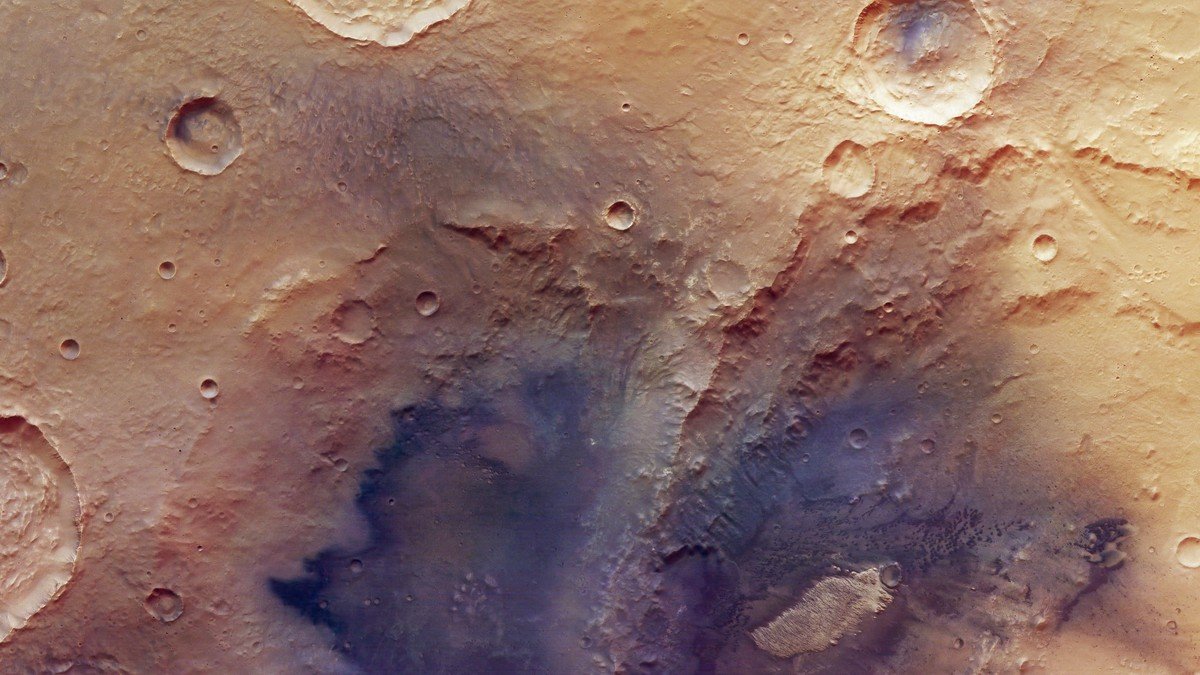
The European Space Agency's (ESA) Mars Express orbiter has beamed back breathtaking high-resolution color stereo mosaic images of Olympus Mons, the largest volcano in the Solar System. The newly processed orbital observations provide scientists with unprecedented structural clarity regarding the ancient volcanic dynamics that shaped the towering Martian shield volcano billions of years ago.
Captured by the High Resolution Stereo Camera (HRSC) operated by the German Aerospace Center (DLR), the image swath focuses on the volcano's dramatic lower slopes and surrounding aureole. The geological data reveals intricate networks of collapsed lava tubes, solidified basaltic channels, and massive debris aprons generated by colossal gravitational landslides.
Unraveling the Giant Caldera and Flank Landslides
Olympus Mons towers roughly 21 kilometers above the surrounding Martian plains, spanning an astonishing base diameter of 600 kilometers—a footprint comparable to the territorial expanse of France. Scientists analyze these topographic mosaics to decode how repeated subterranean magma flows exerted immense pressure on the volcanic edifice, ultimately triggering catastrophic slope failures and cliff collapses.
The stereo imagery also highlights sinuous rilles—troughs formed when molten rock hollowed out underground channels whose roofs subsequently gave way under planetary cooling. These subterranean structural voids are of intense interest to astrobiologists, as intact lava caves could provide radiation-shielded habitats for future robotic instruments or human explorers.
“These extraordinary high-resolution observations reveal the violent geological history of Mars, offering unprecedented details about how massive volcanic flows shaped the Martian crust billions of years ago.”
Two Decades of Discovery and Insights for Future Exploration
Operating in Martian orbit since December 2003, Mars Express continues to perform well beyond its originally envisioned two-year mission lifespan. Its durable suite of scientific payloads has mapped nearly the entire Martian surface in three dimensions, delivering vital clues regarding past hydrological activity, glacial movements, and volcanic resurfacing.
Planetary scientists will integrate the new Olympus Mons datasets into global digital terrain models, assisting international space agencies in evaluating candidate landing sites for upcoming sample-return missions. The remarkable longevity of Mars Express reaffirms the enduring scientific return of international robotic planetary exploration.
Comments (0)
Log in to join the discussion.