

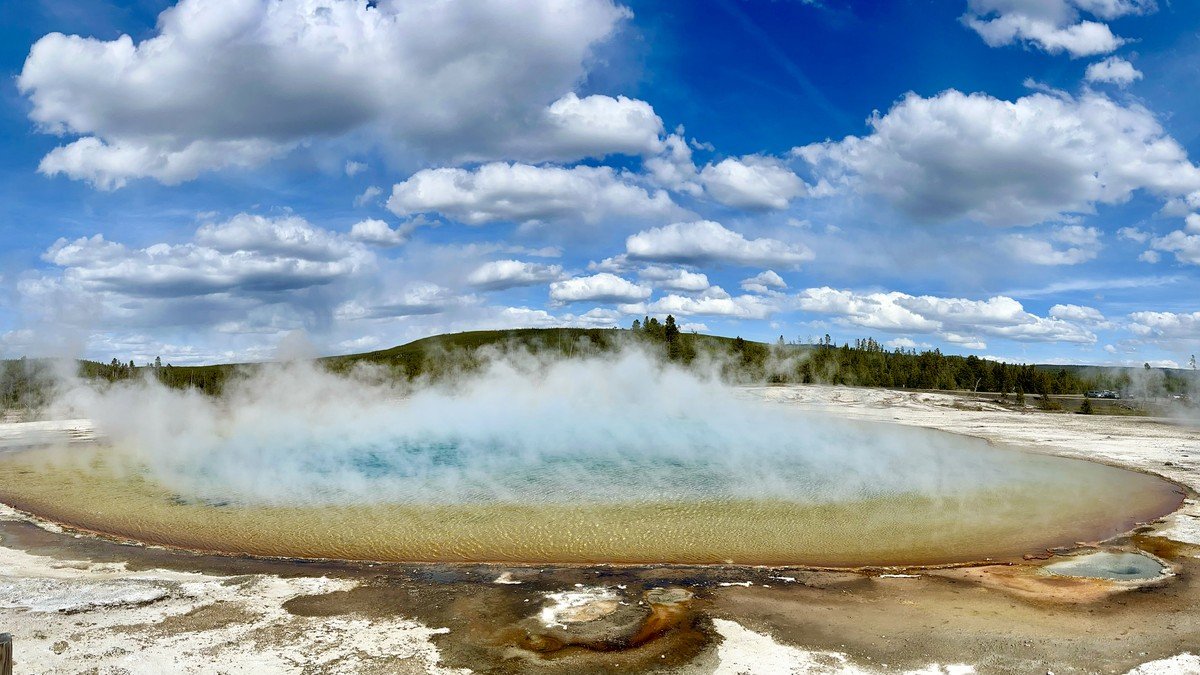
Geophysicists from the US Geological Survey (USGS) and the University of Utah have achieved an unprecedented breakthrough in subsurface imaging, producing the most detailed three-dimensional map to date of the vast lower crustal magma reservoir beneath the Yellowstone supervolcano caldera. The landmark study utilizes advanced seismic ambient noise tomography to peer kilometers beneath the iconic national park.
By analyzing continuous ambient seismic vibrations generated by ocean waves, atmospheric disturbances, and background microseisms, the research team decoded variations in seismic wave speeds across a dense network of hundreds of temporary and permanent seismometers. Slower wave velocities pinpointed regions where heat and fluids soften the rigid basaltic and rhyolitic crust.
Ambient Noise Tomography Unveils Crustal Architecture
The high-resolution tomography revealed that the deep crustal magma reservoir, situated between 20 and 45 kilometers beneath the surface, is dominated by a solid crystal matrix known as a 'crystal mush.' Critically, liquid basaltic melt constitutes only between 16% and 20% of the total reservoir volume, with the remaining 80% to 84% consisting of crystallized mineral grains.
This quantitative assessment resolves decades of intense scientific debate regarding the physical state of the subterranean magma chamber. Because the melt fraction remains well below the critical 35% to 50% rheological threshold required for magma to mobilize, coalesce, and ascend toward the surface, the system remains locked in a stable, non-eruptible phase.
“Our high-resolution imaging demonstrates that the Yellowstone reservoir contains far more solid crystal matrix than eruptible liquid melt, providing crucial baseline insights for long-term volcanic hazard assessment.” — Michael Poland, Scientist-in-Charge at the Yellowstone Volcano Observatory
Why the Low Melt Fraction Precludes an Imminent Super-Eruption
The findings also clarify the relationship between the deeper basaltic reservoir and the shallower rhyolitic chamber located 5 to 10 kilometers beneath Yellowstone's geyser basins. Researchers observed distinct conduit structures through which mantle-derived heat transfers upward to power geothermal spectacles like Old Faithful, without mobilizing mass quantities of eruptive magma.
The Yellowstone Volcano Observatory emphasized that while hydrothermal explosions and localized earthquake swarms remain regular natural hazards within the park, catastrophic volcanic eruptions remain extremely remote geological possibilities. The newly established tomographic baseline will allow automated monitoring networks to detect any future influx of fresh mantle magma with pinpoint accuracy.
Frequently Asked Questions
What percentage of Yellowstone's magma reservoir is liquid melt?
Seismic tomography revealed that only 16% to 20% of the reservoir is liquid melt, while over 80% consists of solid crystal mush.
Could the Yellowstone supervolcano erupt in the near future?
No. Magma chambers require between 35% and 50% melt to become mobile enough to erupt, confirming Yellowstone is not poised for eruption.
Comments (0)
Log in to join the discussion.