

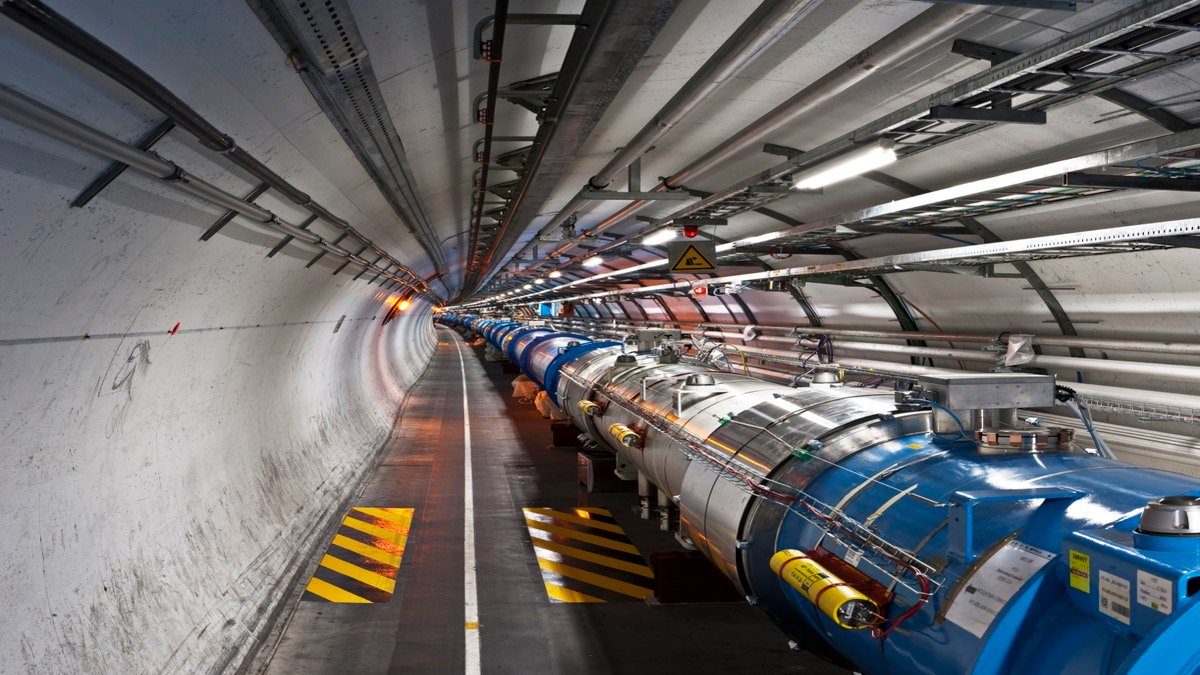
The European Organization for Nuclear Research (CERN) achieved a historic milestone in particle accelerator engineering today, completing the lowering and precision alignment of the final string of next-generation superconducting quadrupole magnets into the 27-kilometer Large Hadron Collider (LHC) tunnel beneath the Franco-Swiss border.
The installation represents a decisive step in the High-Luminosity LHC (HL-LHC) upgrade project, which aims to increase the accelerator's collision rate tenfold by 2029, allowing international physicists to observe exceedingly rare quantum phenomena beyond the Standard Model.
Niobium-Tin Superconductivity Reaching 12 Tesla
Unlike the titanium-niobium magnets currently powering the LHC, the new inner-triplet magnets utilize an advanced niobium-tin (Nb3Sn) superconducting alloy capable of producing magnetic fields exceeding 12 tesla at superfluid helium temperatures of 1.9 Kelvin (-271.3°C).
Developed through an intensive transatlantic collaboration between CERN, the United States Department of Energy's LHC Accelerator Upgrade Project (AUP), and Japanese research institutes, these magnets will squeeze passing proton bunches into microscopic focal points measuring less than a fraction of a human hair.
“The successful integration of these pioneering magnets demonstrates the triumph of global scientific collaboration and paves the way for physics exploration on an unprecedented scale.”
Unlocking the Secrets of the Higgs Boson and Dark Matter
By multiplying the collision density by an order of magnitude, the HL-LHC will produce more than 15 million Higgs bosons per year, enabling scientists at the ATLAS and CMS experiments to measure fundamental particle interactions with unprecedented statistical precision.
Commissioning tests will continue through the current long technical stop, preparing the upgraded beamlines for full-intensity high-energy proton operations.



Comments (0)
Log in to join the discussion.